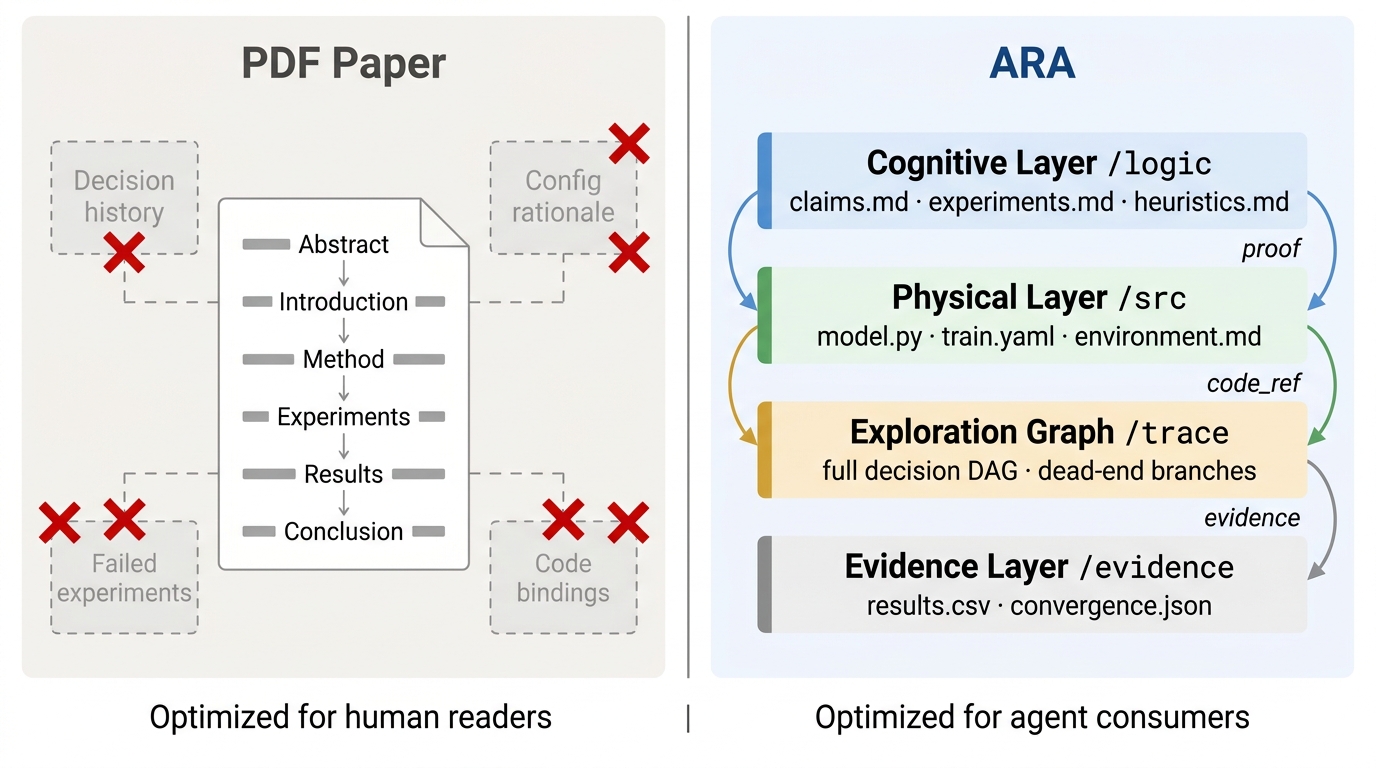
The ARA (Agent-Native Research Artifact) project proposes a new approach to automated research, transforming fragmented AI agent logs into structured and verifiable knowledge packages.


What Happened
The ARA (Agent-Native Research Artifact) ecosystem has been introduced, providing a set of skills for capturing, compiling, verifying, and visualizing the outputs of AI agents. The project allows for packaging logic, source code, and research trajectories into machine-readable artifacts, ensuring transparency in automated processes.
Context
In modern automated research, there is a "black box" problem where the actions of AI agents are not easily auditable. ARA aims to solve this problem by transitioning AI from being simple text generators to becoming full-fledged scientific tools capable of reproducible results.
Why It Matters for the Industry
For the industry, this project creates a standard for documenting and auditing AI agent actions. This enables the scaling of the scientific process without losing rigor and paves the way for integrating similar verification protocols into popular frameworks like LangChain or CrewAI, as well as into existing CI/CD pipelines.
Why It Matters for Users
Researchers and R&D teams gain the ability to use AI as a true scientific partner. The results of agent workflows can now be more than just read; they can be verified, reproduced, and integrated into structured knowledge bases, significantly reducing the risk of hallucinations in technical tasks.
Sources
Author
Look at AI, Editorial Staff