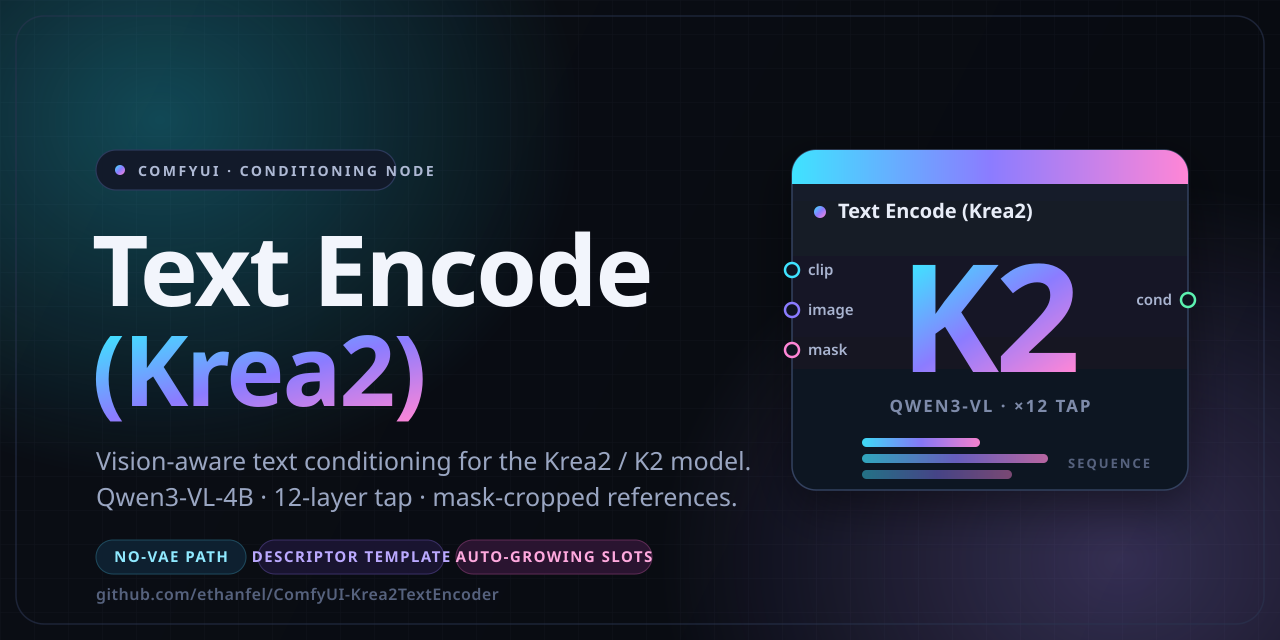
Developers have introduced the ComfyUI-Krea2TextEncoder custom node, which allows the use of images and masks to refine prompts in the Krea2 model through vision-aware text conditioning mechanisms.

What Happened
A new node, ComfyUI-Krea2TextEncoder, has been released for the ComfyUI ecosystem, designed to work with the Krea2 model (kreaturbo.safetensors). The tool utilizes the Qwen3-VL-4B model as a vision-aware encoder, allowing users to dynamically add image+mask pairs to control the generation process. The node correctly applies the Krea2 descriptor template, ensuring compatibility with the target model.
Context
Traditional generation control methods in DiT (Diffusion Transformer) models are often limited to text descriptions. Using multimodal Vision-Language Models (VLM), such as Qwen3-VL-4B, allows for the translation of visual signals into a feature space understandable by text conditioning, creating a "Vision-to-Prompt" pattern.
Why It Matters for the Industry
This tool expands control capabilities in multimodal DiT models, demonstrating the potential of using VLM encoders to enrich prompts. In the long term, this could lead to the standardization of vision-to-text conditioning approaches, where VLMs act as the bridge between visual input and the latent space of generative models.
Why It Matters for Users
For professional artists and designers working in ComfyUI, this means the possibility of much more precise control over style and fine details. Instead of writing complex text descriptions, users can use specific areas on reference images to guide the final result.
What Is Not Yet Known / Limitations
Integrating this solution into real-world production workflows may require assessing the impact of additional VLM inference on system latency.
Sources
Author
Look at AI, Editorial Team