
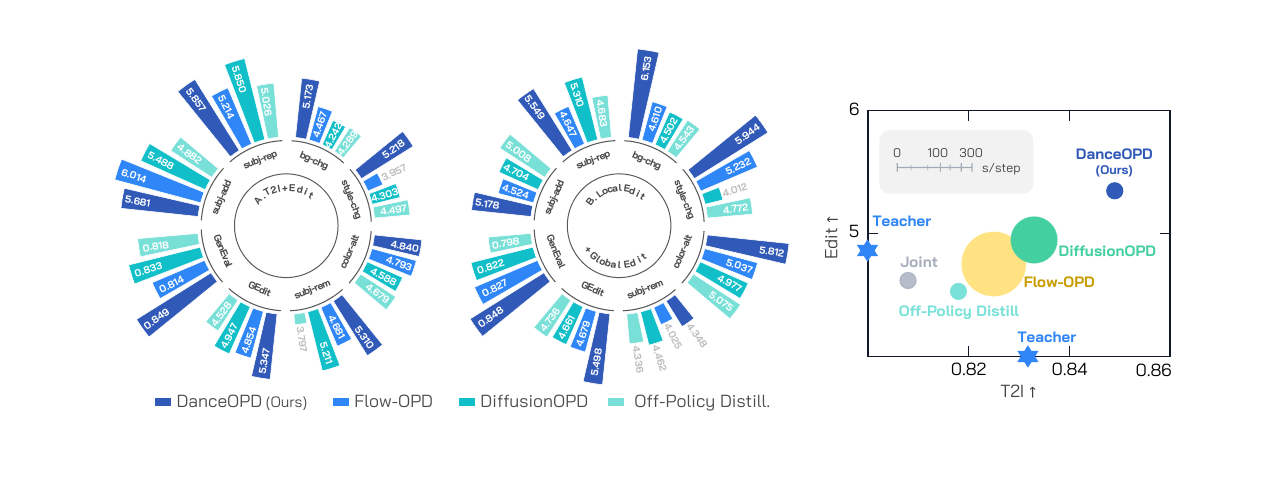
DanceOPD has been introduced—an innovative framework for generative field distillation, optimized specifically for flow-matching architectures. This technology allows for the unification of fundamentally different tasks within a single compact model: text-to-image generation, as well as local and global image editing, without sacrificing the quality of the base generation.


What Happened
Developers have presented a hard-routed on-policy training method. In this scheme, the "student" model is trained on its own results (rollouts), adapting to the velocity fields of expert models. This allows for the effective integration of Classifier-Free Guidance (CFG) into the distillation process for flow-matching architectures and the unification of Text-to-Image (T2I) with various object editing modes.
Context
Traditionally, when attempting to combine several heterogeneous tasks (such as high-quality generation and precise editing) into a single neural network, quality degradation or gradient conflicts occur. This forces users to use a chain of several specialized tools to achieve a final result.
Why It Matters for the Industry
DanceOPD offers a solution to the fundamental problem of multi-task learning in generative models. This paves the way for creating universal "all-in-one" models based on flow-matching that are capable of seamlessly switching between styles and editing methods, becoming more compact and efficient alternatives to fragmented pipelines.
Why It Matters for Users
For end users, this means a transition from complex multi-step processes (generation, then masking, then inpainting) to a single interface. It is now possible to create models that can simultaneously excel at drawing new images and professionally editing details within a single inference pass.
What Is Not Yet Known / Limitations
At the moment, data regarding latency and open-source availability are missing, which makes it difficult to assess the practical applicability of the framework in real production environments.
Sources
- DanceOPD: On-Policy Generative Field Distillation (Project Page)
- DanceOPD: On-Policy Generative Field Distillation (arXiv:2606.27377)
Author
Look at AI, Editorial Team