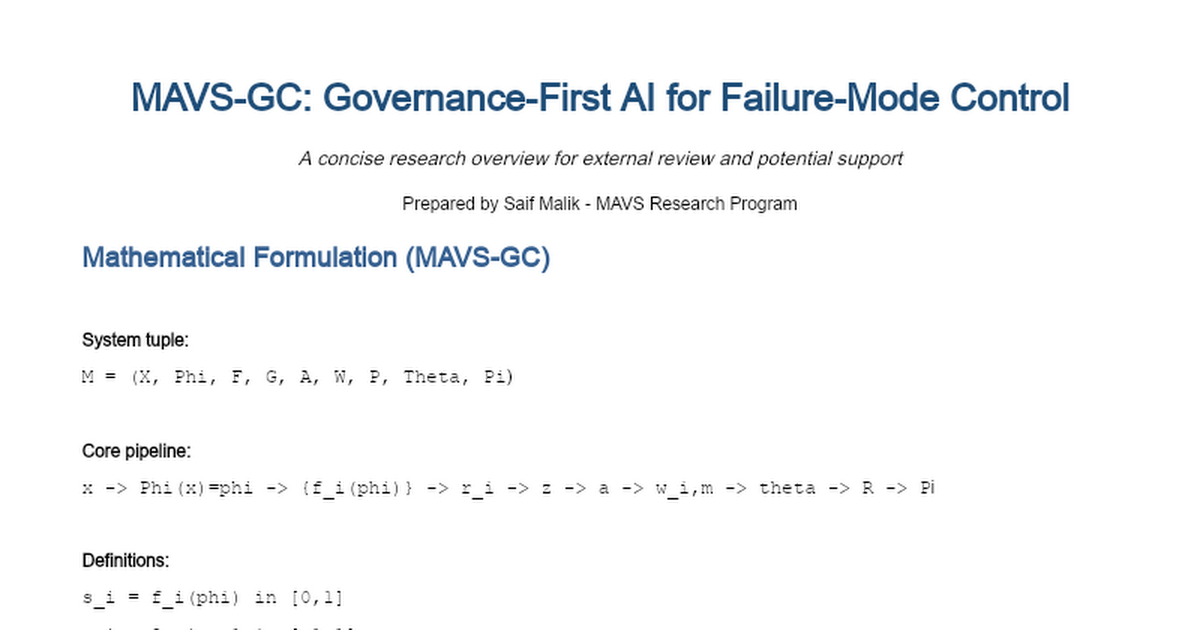
MAVS-GC (Multi Adaptive Vetting Systems-Governance Core) has been introduced—an open-source governance architecture for AI systems that separates the expert prediction level from the decision-making level. The development demonstrates high resilience to data corruption, maintaining 85.30% accuracy even under critical noise levels.

What Happened
Developers have presented MAVS-GC, an architecture that implements a formalized governance layer on top of model ensembles. In conditions of high data corruption (level ≥ 0.6), the system demonstrated 85.30% accuracy with an unsafe decision rate of only 0.45%, whereas standard ensembles achieved only 43.24% accuracy with an error rate of 67.61%. The architecture ensures the creation of an auditable decision trace.
Context
Traditional AI methods often rely on simple ensemble averaging of neural network responses, making them vulnerable to data degradation or adversarial attacks. MAVS-GC changes this approach by introducing trust assessment mechanisms and signal diagnostics at a separate governance level.
Why It Matters for the Industry
Moving from simple response aggregation to dedicated governance layers allows for the creation of more reliable systems capable of "failing safely" during attacks. This lays the foundation for the standardization of "auditable AI," where governance becomes an integral part of high-reliability system architectures (AI Orchestration).
Why It Matters for Users
For users, this represents a step toward creating predictable AI whose behavior can be audited and controlled without the need to retrain every individual model within an ensemble. This is critical for deploying AI in environments with high reliability requirements.
What Is Not Yet Known / Limitations
Currently, there is no data regarding key production metrics such as latency, throughput, and cost, which makes it difficult to assess the solution's readiness for industrial implementation.
Sources
- MAVS-GC: Governance-First AI for Failure-Mode Control (Research Document)
- MAVS-RESEARCH GitHub Organization
Author
Look at AI, Editorial Staff