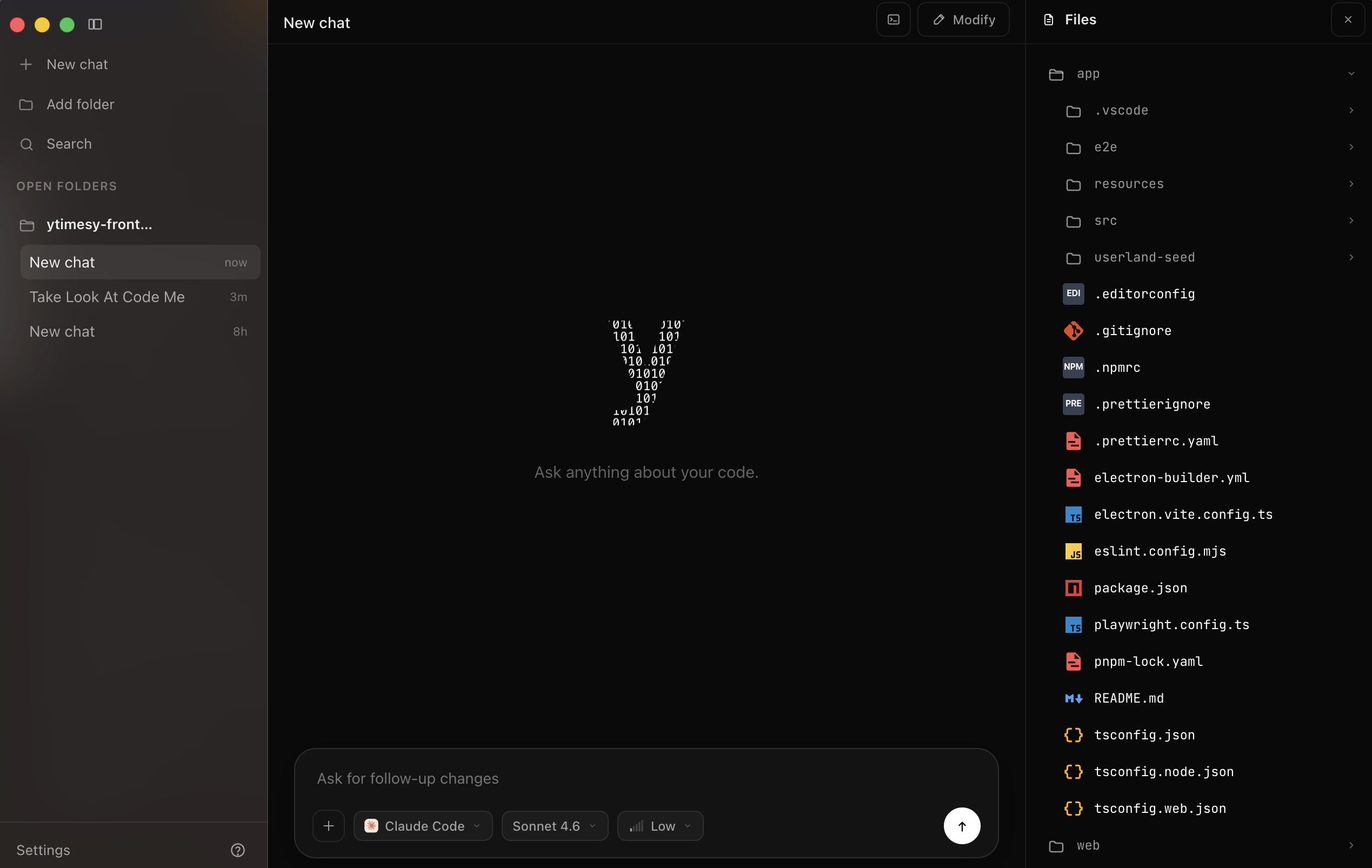
Developers have introduced Y — a new Electron-based desktop application designed for interacting with coding agents like Claude Code and OpenAI Codex. The key feature of the project is the concept of a "malleable" interface that can change dynamically in real time.

What Happened
The Y application has been released, allowing users and LLM agents to modify the user interface via a special "Modify" mechanism using a text chat. The system architecture is divided into a secure Kernel and a mutable Userland, which allows agents to be safely provided with tools to transform the working environment.
Context
Traditional Integrated Development Environments (IDEs) typically have a static set of tools and a fixed UI. Project Y proposes a paradigm shift toward Agentic UI, where the boundaries between a software product and its configuration are blurred, turning the tool into an adaptive environment that adjusts to the specific workflow of an agent or a human.
Why It Matters for the Industry
For the software development industry, this signifies the emergence of a new design pattern for agent-driven tools. The project demonstrates the possibility of creating highly adaptive environments where the interface becomes a dynamic output parameter of LLM operations, which could lead to a rise in specialized open-source frameworks for agentic workspaces.
Why It Matters for Users
Developers gain the ability to turn a static editor into a "living" environment that automatically adapts to their coding style and current tasks. Meanwhile, the separation of Kernel and Userland ensures that dynamic UI changes do not compromise basic code execution security.
What Is Not Yet Known / Limitations
The project is a proof of concept (PoC) and is experimental in nature. There are concerns regarding Electron's performance when scaling, as well as questions about the architecture's reliability during deep integration into large-scale enterprise processes.
Sources
Author
Look at AI, Editorial Team