
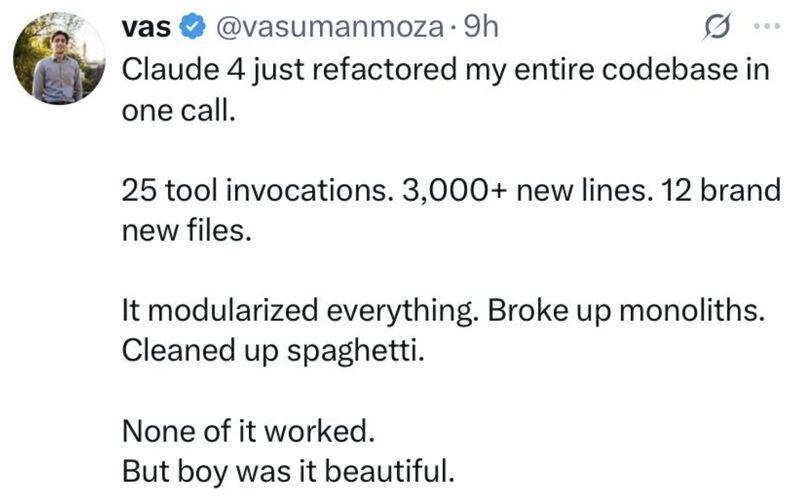
Developers are facing a new risk — "vibe coding," where using AI assistants to generate code replaces deep architectural analysis with superficial checks of functionality. This creates a threat of forming "super-funds of legacy code" that will be impossible to maintain in the future, neither by humans nor by modern AI agents.

What Happened
William Angel warned of the "vibe coding" phenomenon, where developers rely on an intuitive perception of LLM output without a detailed understanding of the implementation logic. This leads to the creation of systems whose complexity grows exponentially, turning projects into "technical tarpits" — uncontrollable and indecipherable code structures.
Context
The problem arises because modern LLMs allow for significantly faster prototyping and MVP development; however, this acceleration masks architectural errors. Using AI to generate code without strict auditing replaces the verification of architectural correctness (correct code) with a simple check of functionality (working code).
Why It Matters for the Industry
For the AI industry and companies, this means the risk of creating massive legacy systems that cannot be modified using standard methods. This could slow down the adoption of new technologies and create a need for fundamentally new tools for automated architectural audit and code verification.
Why It Matters for Users
Developers should not blindly rely on AI output. A lack of deep understanding of the code structure deprives them of the ability to notice errors in time and optimize the system, laying a "time bomb" under a project that will eventually become too complex to maintain.
Sources
Author
Look at AI, Editorial Team