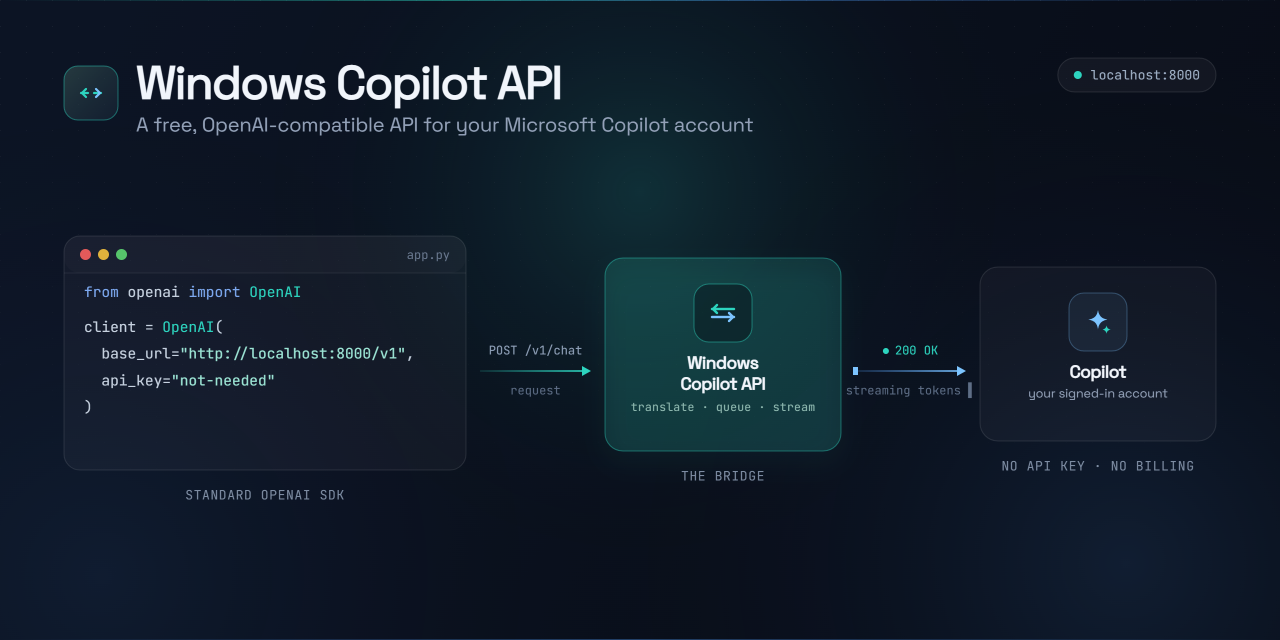
Developer sums001 has introduced the Windows-Copilot-API project, which allows the capabilities of Microsoft Copilot to be used through a standard OpenAI-compatible interface. The tool provides access to powerful models, including GPT-4, without the need to pay for official API keys, requiring only an active Microsoft account.

What Happened
Windows-Copilot-API has been released—a solution that works as a local server (via Python or Docker) or a library. The project implements reverse engineering of the Microsoft Copilot web interface, creating a layer that mimics web user requests. According to GPQA Diamond tests, the models available through this method demonstrate a score of 40.9%, which is consistent with the GPT-4 level.
Context
Traditionally, using advanced LLM models via official APIs requires paying per token or having a paid subscription. Windows-Copilot-API bypasses these restrictions by utilizing the existing free capabilities of the Microsoft web interface, providing a technical proxy/wrapper for automation.
Why It Matters for the Industry
The project demonstrates the effectiveness of reverse engineering web interfaces to bypass commercial API restrictions. This creates "gray" paths for accessing powerful models, which may stimulate the development of zero-cost prototyping tools, but also forces providers (in this case, Microsoft) to strengthen protective measures, such as CAPTCHA and behavioral analysis.
Why It Matters for Users
Developers and enthusiasts can integrate Copilot capabilities into their own applications, scripts, or RAG systems that support the OpenAI standard for free. This significantly lowers the barrier to entry and the cost of developing an MVP for small teams, allowing them to quickly test complex AI workflows using only free accounts.
What Is Not Yet Known / Limitations
The method is a "gray" way of bypassing monetization mechanisms and cannot be considered legal or stable for industrial use (production). There is a high risk of bans and instability due to the dependency on the structure of the Microsoft web interface and the lack of SLA guarantees.
Sources
Author
Look at AI, Editorial Team