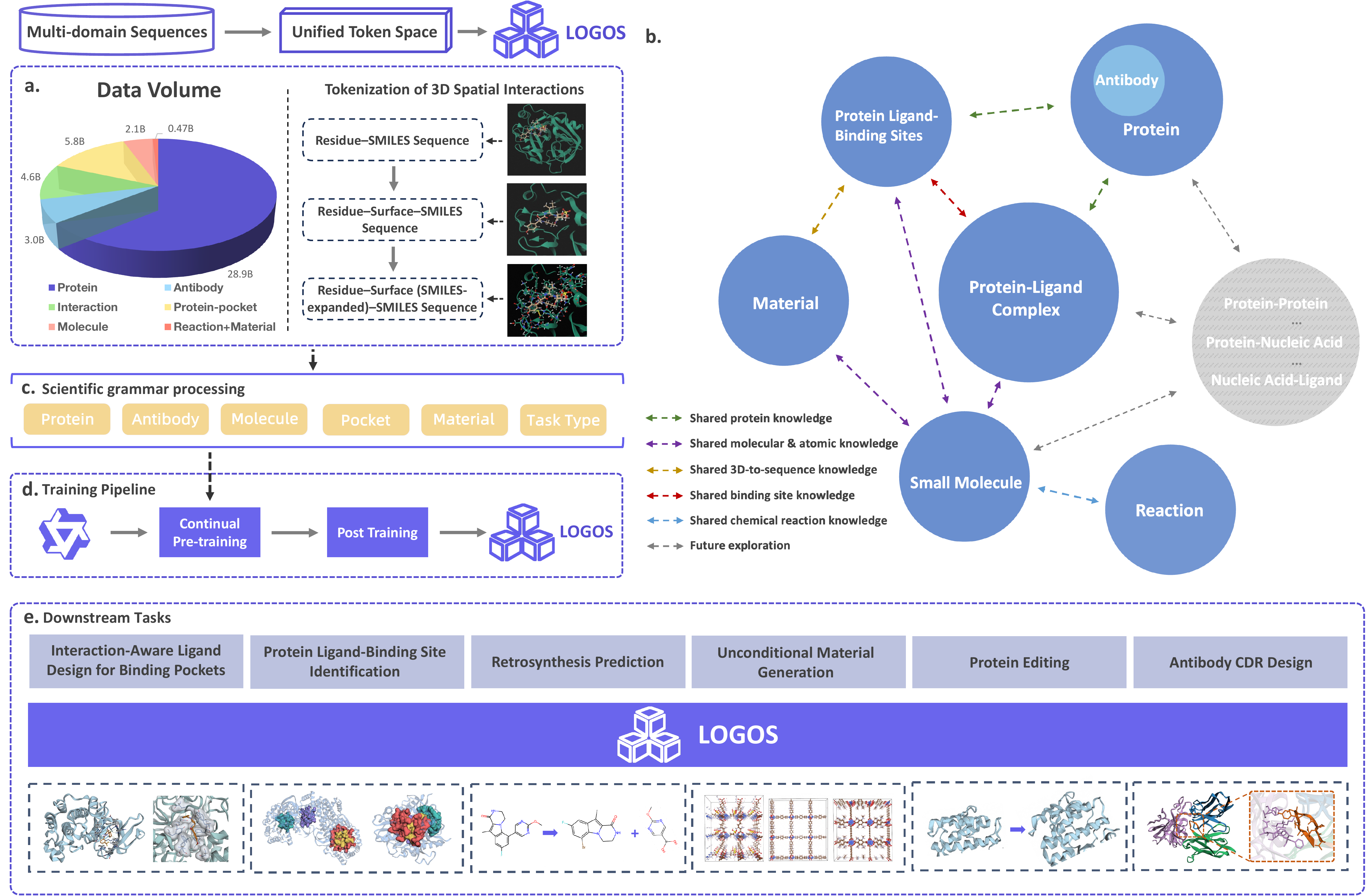
Alibaba Group has introduced LOGOS (Language Of Generative Objects in Science) — the first universal generative model designed for the natural sciences. Using a unified "scientific grammar," the model is capable of encoding various types of data, including proteins, molecules, chemical reactions, and materials, into a single sequence of tokens.


What Happened
Alibaba Group released the LOGOS model family, consisting of four versions: pre-trained models with 1B, 3B, and 8B parameters, as well as a specialized fine-tuned version, LOGOS-8B, for solving applied tasks. Training was conducted on a massive corpus including 44 billion tokens, combining seven different types of scientific data.
Context
Traditionally, scientific research in biology, chemistry, and materials science has relied on highly specialized models designed for specific types of tasks. LOGOS implements a transition toward the concept of foundation models in science, creating a common interface for representing heterogeneous objects through a discrete tokenized space.
Why It Matters for the Industry
For the industry, this signifies a shift from fragmented specialized tools to unified architectures, allowing for synergy between different scientific disciplines. Utilizing common LLM approaches simplifies the training process and opens possibilities for creating cross-domain AI agents capable of working at the intersection of biochemistry and materials science.
Why It Matters for Users
Researchers and developers gain access to a powerful open-source foundation. Thanks to open weights on Hugging Face and code on GitHub, teams can immediately begin experimenting, performing local deployment, and fine-tuning models for specific tasks—such as creating certain classes of antibodies—without having to train the system from scratch.
What Is Not Yet Known / Limitations
There are varying assessments regarding the technology's readiness for mass adoption: while researchers express optimism, engineers and architects point to potential complexities in integrating such models into existing production environments and corporate standards.
Sources
- arXiv paper: Speaking the Language of Science
- LOGOS-Hub GitHub Repository
- LOGOS-Hub Hugging Face Models
Author
Look at AI, Editorial Team