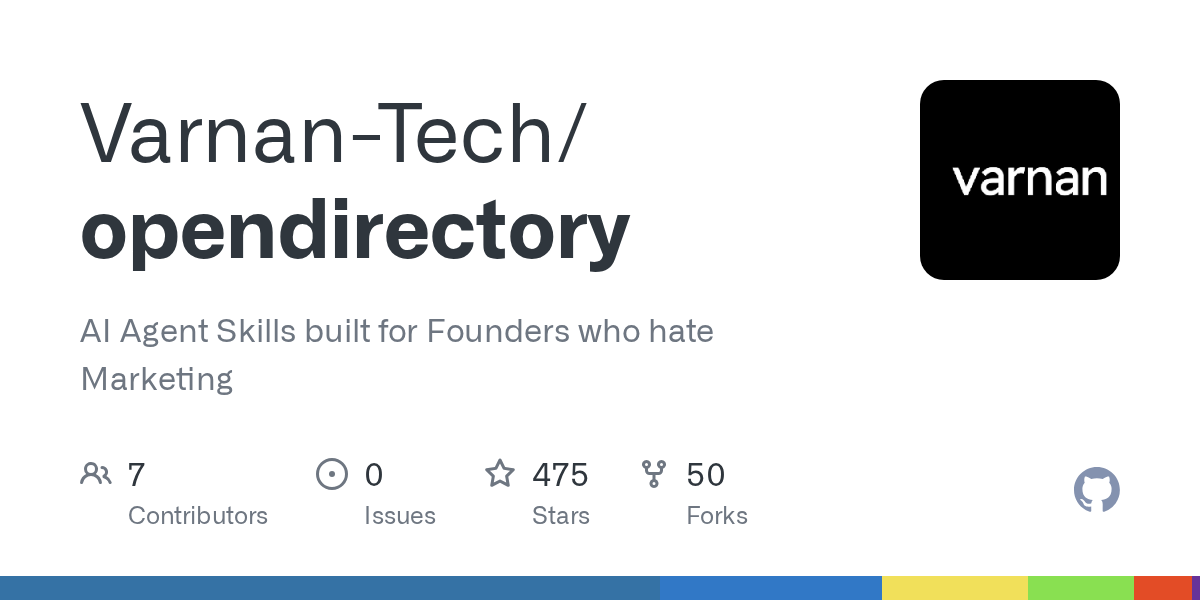
OpenDirectory has launched—a library of ready-made skills for AI agents, designed to automate marketing and Go-To-Market tasks. The tool allows developers and founders to install specialized sets of instructions and context directly into their agents, such as Claude, Gemini, or Hermes, via npx or CLI commands.
What Happened
Developers have introduced OpenDirectory, which offers over 60 ready-made skills for AI agents. The library includes tools for creating LinkedIn content, conducting pricing page audits, and searching for hiring signals via X/Twitter. Modules are installed programmatically, turning text instructions into distributable components.
Context
The project is an engineering solution for modularizing prompt engineering. Instead of manually writing complex system prompts, developers are moving toward a "skill-as-a-module" concept, which allows for standardizing agent behavior in specific business domains without requiring a deep understanding of prompt engineering methods.
Why It Matters for the Industry
For the industry, this is an important step toward the modularity of AI agents. The project demonstrates a shift from "prompt as code" to the programmatic installation of ready-made modules, simplifying the integration of business logic into LLM applications. In the long term, this could lead to the standardization of skill transfer protocols between different LLM providers, reducing vendor lock-in.
Why It Matters for Users
Developers and startup founders can significantly accelerate the prototyping of marketing and analytical functions. Using ready-made instruction libraries allows them to instantly add marketing expertise to their products, saving time on the manual development of complex system prompts.
What Is Not Yet Known / Limitations
Technical specialists note that this is an engineering abstraction solution rather than a fundamental scientific breakthrough in model architecture. Additionally, further evaluation is required regarding the reliability of these instructions when used in production environments.
Sources
Author
Look at AI, Editorial Team