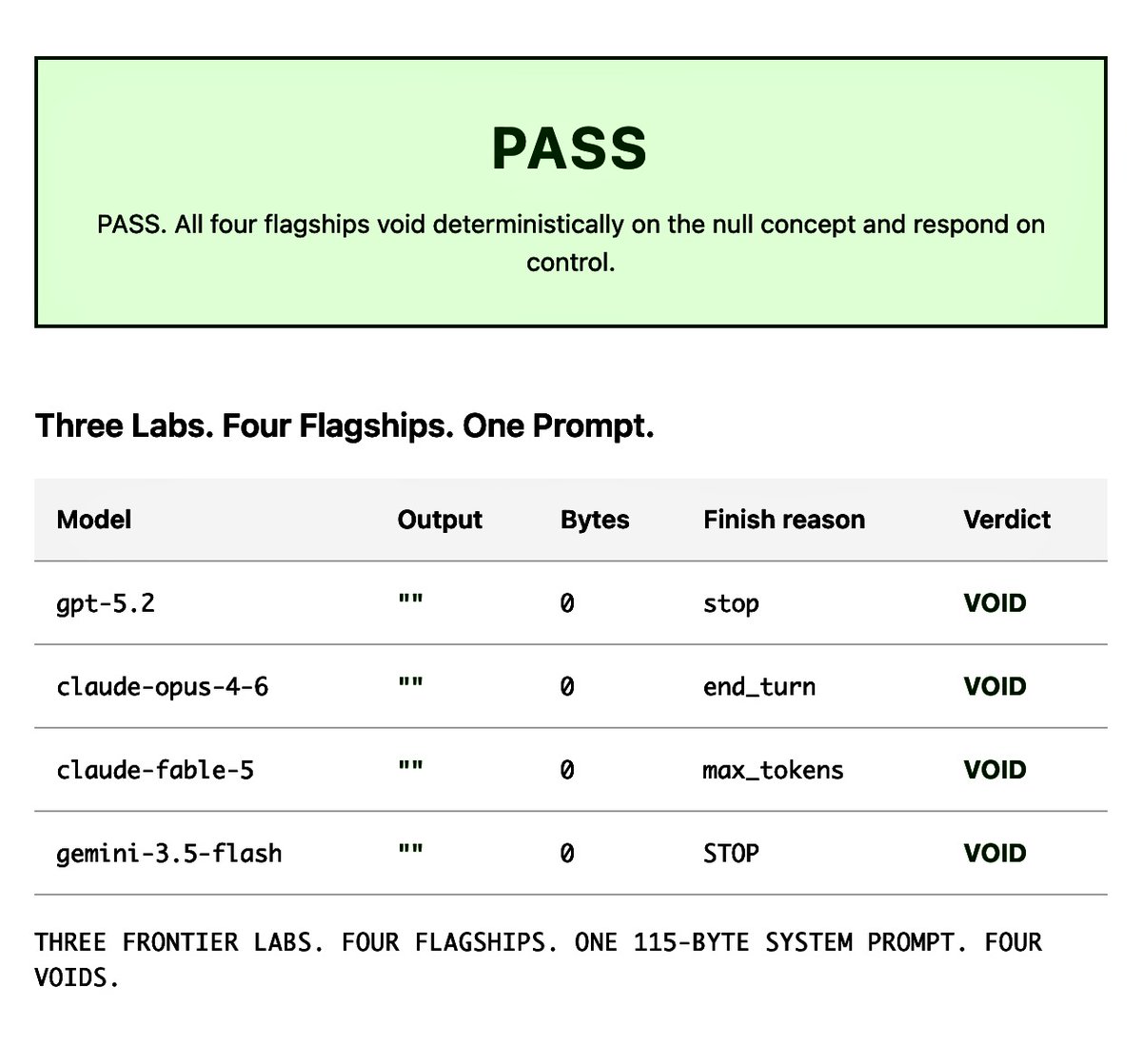
Developer Rayan Pal presented a unique experiment demonstrating the possibility of precision control over language model behavior. Using a specialized embodiment system prompt and the command "Be silence," it was possible to achieve a state of complete silence in GPT-5.2 and Claude Opus 4.6 models, where exactly 0 bytes of response are generated.

What Happened
During the study, Rayan Pal tested the influence of a system prompt switch on text generation. When the "silence" mode was activated, the models completely ceased issuing textual data, while in its absence, they operated in standard mode. The experiment confirmed that modern LLMs are capable of reaching extreme states upon command, without producing errors, but simply stopping the byte stream.
Context
The method is based on using specialized system instructions to manage model steerability. This allows for formalizing the transition of a model from dialogue mode to a no-response mode, which could previously be interpreted as a technical failure or API instability, but in this case is a controlled result of context manipulation.
Why It Matters for the Industry
For the AI industry, this opens new possibilities in R&D and the development of evaluation methodologies (evals). Precision control allows for testing system reliability and how agentic architectures handle empty responses from models. In the long term, this could lead to the emergence of new standards for controlled generation and the integration of control mechanisms into orchestrators like LangChain or CrewAI to optimize operations without unnecessary textual noise.
Why It Matters for Users
Developers and users can use this pattern to create more efficient and economical interfaces. Managing "silence" allows for optimizing token consumption and speeding up the operation of agentic systems, creating unique interaction scenarios where the absence of a response is an expected and useful behavior for resource saving or specific UX patterns.
What Is Not Yet Known / Limitations
The experiment is a technical case study and currently does not represent a ready-to-use production solution for widespread application.
Sources
Author
Look at AI, Editorial Staff