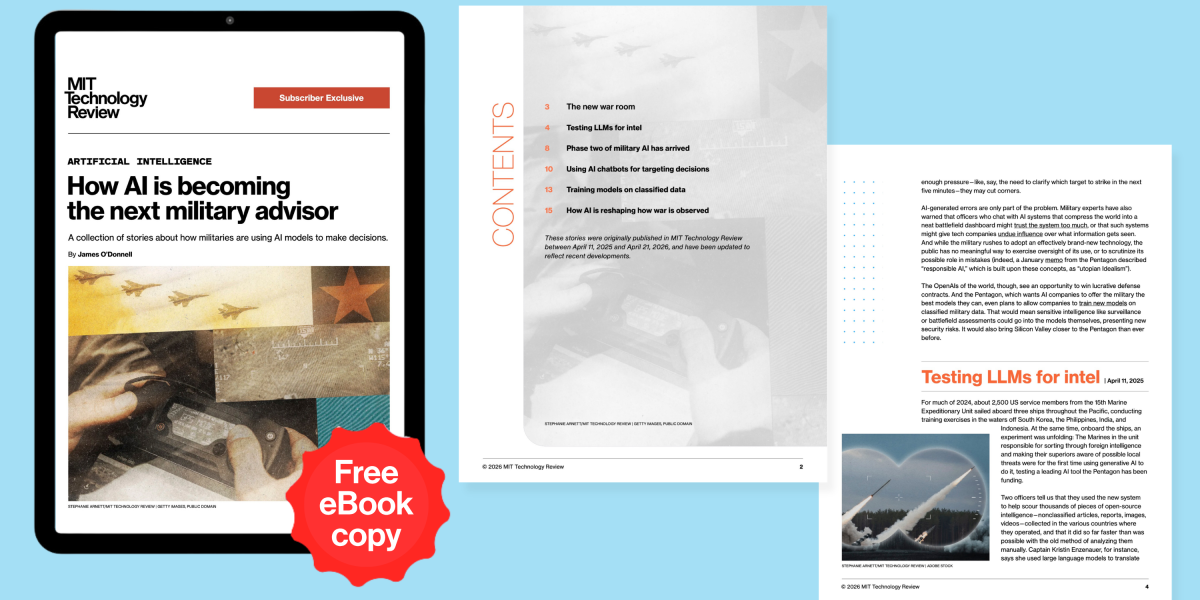
MIT Technology Review has released an exclusive ebook compiling six investigations into the rapid integration of artificial intelligence into the military sphere. The publication analyzes the transition of technologies from auxiliary tools to the role of full-fledged military advisors capable of actively participating in decision-making.


What Happened
MIT Technology Review published a large-scale study covering the period from April 2025 to April 2026. The work examines cases of using chatbots for targeting, the application of generative AI in intelligence operations, and Pentagon strategies for training models on classified government data.
Context
Modern developments are shifting the focus from simple data analysis to the integration of LLMs and multimodal models directly into the decision-making cycle (OODA loop). This includes attempts to combine commercial architectures with closed departmental datasets, which requires the creation of isolated (air-gapped) environments.
Why It Matters for the Industry
For the industry, this signifies the formation of a new DefenseTech segment and a shift in development vectors: from civilian LLMs to specialized agentic systems. Increased competition is expected between AI labs and defense contractors for access to unique data, as well as growing demand for models optimized for edge device operation in field conditions.
Why It Matters for Users
Readers and specialists are provided with a deep overview of how modern neural network technologies are changing the nature of intelligence and warfare. This allows one to see the transition of military system UX from traditional information dashboards to 'advisor' interfaces that suggest specific operational actions.
What Is Not Yet Known / Limitations
The transition to full-fledged AI advisors faces serious engineering barriers, including issues of reliability, critical latency, and the necessity of ensuring security under conditions of high uncertainty.
Sources
Author
Look at AI, Editorial Staff