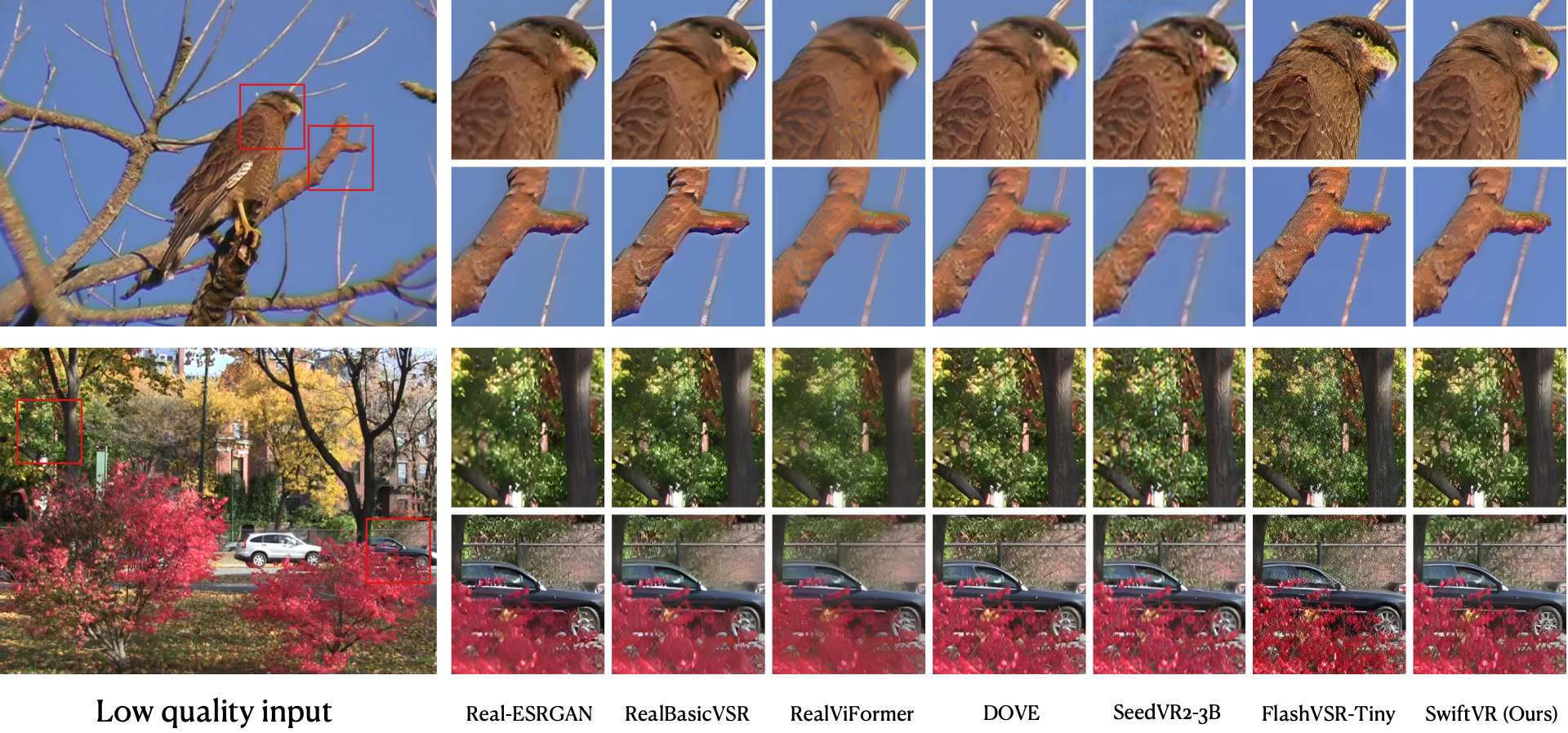
SwiftVR has been introduced—an innovative generative model providing high-quality video restoration in real-time. The technology achieves 1080p resolution at ~26 FPS on consumer GPUs like the RTX 5090 and supports 4K on professional H100 cards at 14 FPS.

What Happened
The SwiftVR project is based on the Wan2.2-TI2V-5B architecture and utilizes three key technical innovations: Mask-free shifted-window self-attention (MFSWA) to accelerate transformer performance by 1.62x, a Restoration-aware Autoencoder (ReAE) to minimize decoding latency, and a causal chunk-wise streaming restoration protocol.
Context
Traditional diffusion models for high-resolution upscaling often face critical issues with computational complexity and Out-of-Memory (OOM) errors. This is due to the use of heavy 3D-VAEs and tiling decoding methods, which prevent real-time operation.
Why It Matters for the Industry
SwiftVR offers an efficient alternative to existing methods by solving the quadratic attention complexity problem at high resolutions. This sets a new optimization standard for video diffusion models and could lead the industry to transition from heavy 3D-VAEs to lightweight specialized autoencoders.
Why It Matters for Users
The technology makes high-quality video restoration accessible on home gaming PCs rather than just server clusters. This opens new possibilities for using AI upscaling in streaming, video games, and local video editing tools.
What Is Not Yet Known / Limitations
Despite the high performance, initial user tests indicate inconsistent visual quality and a need for further refinement in restoration accuracy.
Sources
Author
Look at AI, Editorial Team