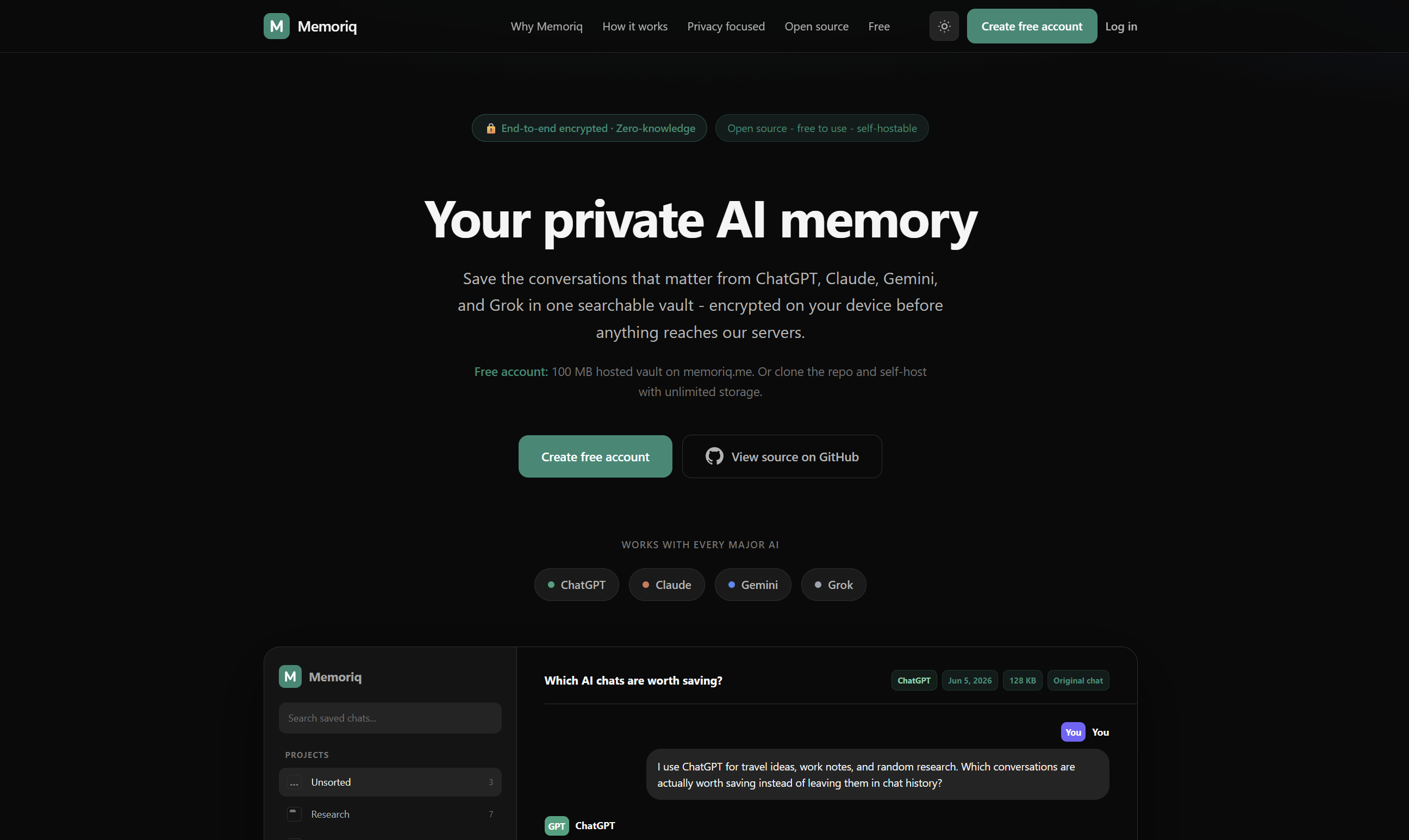
Memoriq, an open-source project, has been introduced—a secure repository for saving and searching conversation histories with various AI assistants such as ChatGPT, Claude, Gemini, and Grok. The system provides end-to-end encryption (E2EE) on the browser side, guaranteeing complete privacy of user data.


What Happened
Memoriq developers have released an open-source project that allows users to aggregate dialogues from different AI services into a single knowledge base. By using E2EE directly in the browser, servers do not gain access to message text, headings, or metadata. Users can organize chats by projects, perform local searches on decrypted data, and manage encrypted backups.
Context
With the mass adoption of LLMs, the problem of data fragmentation between providers and the risk of intellectual property leaking into neural network training sets has emerged. Existing services rely on privacy policies rather than mathematical guarantees of data protection.
Why It Matters for the Industry
The project offers an alternative model for Personal Knowledge Management (PKM), where privacy is technically ensured through client-side encryption. This could contribute to a trend toward decentralized "AI memory" management, where user data is separated from computational models.
Why It Matters for Users
Users gain the ability to create a single, secure knowledge base from scattered chats without fearing that their ideas, code, or work notes will end up in third-party service databases. This reduces the risk of sensitive information leaks when working with multiple AI tools simultaneously.
What Is Not Yet Known / Limitations
Technical specialists point to potential challenges related to the scalability of local search and performance when working with large volumes of data in the browser.
Sources
Author
Look at AI, Editorial Staff