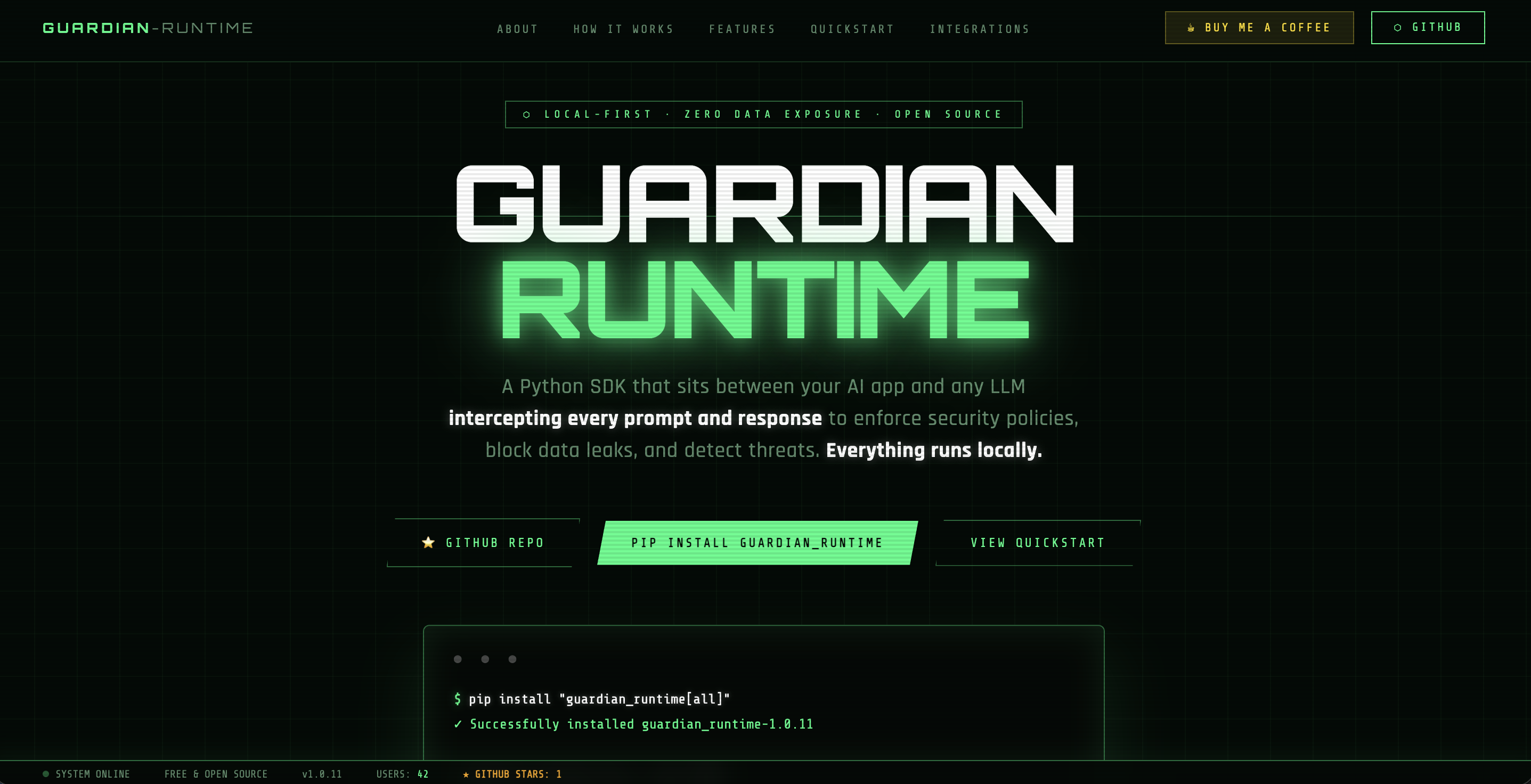
Guardian Runtime has been introduced—a specialized middleware layer designed to manage security and cost optimization when using autonomous AI agents via a local proxy.

What Happened
Developers have released Guardian Runtime, which operates as a local middleware firewall. The tool intercepts requests to LLMs (such as OpenAI and Anthropic) and allows for the setting of strict token usage budgets. In addition to cost control, the solution prevents the leakage of secrets, including API keys and passwords, from agent contexts. It also features a "Terse Mode," which optimizes prompts to reduce output token volume by 40–70%.
Context
With the development of autonomous AI agents, new risks have emerged: unpredictable API expenses (the FinOps problem) and the threat of Data Exfiltration, where agents might accidentally send sensitive data or access keys to cloud models. Current development tools, such as Cursor, Claude Code, or Aider, require an additional layer of control for safe implementation into corporate processes.
Why It Matters for the Industry
The emergence of such solutions is forming a new infrastructure segment: the AI Middleware Firewall. This allows companies to transition from chaotic API consumption to controlled business processes, ensuring compliance with security and budgeting policies. In the long term, similar functions may become standard in base SDKs for LLM applications.
Why It Matters for Users
For developers and users, the tool provides direct control over API bills, protecting against sudden and large expenses. It also minimizes the risk of personal API key compromise when working with agentic tools, providing the ability to immediately implement basic protection and cost control into the workflow.
Sources
Author
Look at AI, Editorial Team